Bolted fault current calculation is a fundamental part of IEEE 1584 guidelines for arc flash analysis. Here’s how it’s calculated and the effect of ground resistance:

How is the Bolted Fault Current Calculation in IEEE 1584-2018 Done?

Bolted fault current is the theoretical current that would flow in the event of a direct (zero-impedance) short circuit, such as if conductors were clamped together without any impedance between them. It’s calculated based on several parameters of the electrical system, including:

  1. System Voltage: The voltage level of the equipment or part of the system where the fault is assumed to occur.
  2. Impedance of the Power System: This includes the impedance of the transformer, cables, and any other devices within the fault loop that may limit the current.
  3. Transformer Characteristics: Including kVA rating, impedance percentage, and primary and secondary voltage.

IEEE 1584 primarily focuses on the bolted fault current because it’s the foundation for determining incident energy and arc flash boundary in a system.

Role of Ground Resistance per IEEE 1584 – 2018

Ground resistance does not play a significant role in the calculation of bolted fault current. Since bolted faults are assumed to have negligible impedance, the current is not influenced by the resistance in the ground path. However, ground resistance may impact other types of faults, such as line-to-ground faults, where impedance in the ground path could affect fault current levels and distribution.
For arc flash studies, IEEE 1584 – 2018 assumes a worst-case bolted fault condition (typically three-phase faults), which simplifies calculations by ignoring the effect of ground resistance, providing conservative estimates for safety.

Definitions Screen Shot from the Standard:

available short-circuit current: At a given point in a circuit, the maximum current that the power system can deliver through a given circuit to any negligible-impedance short circuit applied at the given point, or at any other point that causes the highest current to flow through the given point. “Available short-circuit current” and “bolted fault current” are equivalent for a zero fault impedance.

bolted fault: A short-circuit condition that assumes zero impedance exists at the point of the fault.


Case of Resistance and calculations from the Study
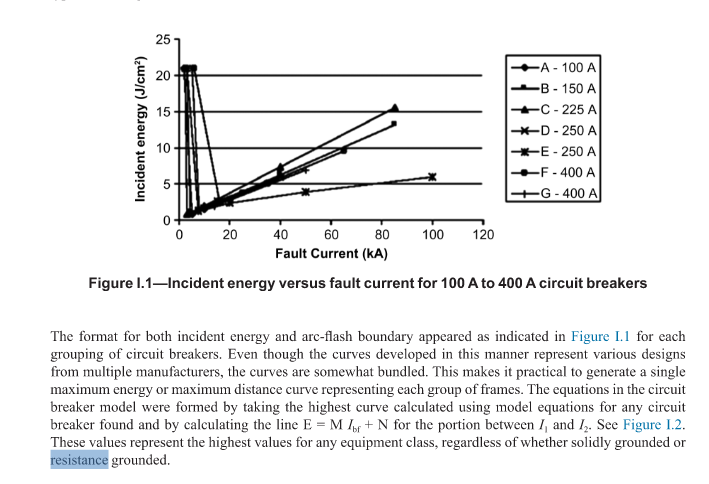
Fault Currents and Ground Resistance

Understanding bolted fault current is essential for accurate arc flash analysis and electrical safety planning. By following IEEE 1584-2018 guidelines, you can ensure safer work environments and compliance with industry standards. For any electrical system, calculating the bolted fault current provides a foundation to evaluate potential incident energy levels and establish necessary arc flash boundaries. Ready to enhance the safety and compliance of your operations? Contact Us today to get expert support on bolted fault current calculations, arc flash studies, and comprehensive electrical safety assessments.

Other Recent Articles

Power System Study

What Is a Power System Study? Types, Purpose, and What Your Facility Gets From One

If your electrical system were a car, a power system study would be the full diagnostic, not the oil change. It looks at how the entire system behaves under normal loads and during faults, then tells you whether your equipment and protective devices are up to the job....
Energized vs. De-Energized Work

Energized vs. De-Energized Work: When NFPA 70E Requires an Energized Electrical Work Permit

"It'll only take five minutes, just leave it on." Every facility has heard some version of that sentence. It's also how a lot of serious electrical injuries begin. NFPA 70E is clear on this point: working on live equipment is the exception, not the rule. When it is...
Electrical Metering

Electrical Metering for Facility Managers: What It Measures, Why It Matters, and When You Need It

Most facility managers get one number about their electricity each month: the total on the utility bill. It tells you what you spent. It doesn't tell you where the power went, when demand peaked, or whether your equipment is being stressed by the electricity feeding...
LOTO Compliance Checklist

LOTO Compliance Checklist: How to Audit Your Lockout/Tagout Program Before OSHA Does

Having a lockout/tagout program on paper and having one that would survive an OSHA inspection are two different things. LOTO violations consistently rank among OSHA's most frequently cited standards, and the gaps that get facilities in trouble are rarely dramatic....
Electrical Engineering Consultant

What Does an Electrical Engineering Consultant Actually Do? Services, Process, and What to Expect

An electrical engineering consultant analyzes your facility's electrical systems, identifies risks and inefficiencies, performs technical studies, and delivers documentation that helps you make informed decisions about safety, compliance, and infrastructure planning....
Arc Flash Study Report

How to Read Your Arc Flash Study Report: A Plain-English Guide for Facility Managers

An arc flash study report tells you how much energy could be released at each point in your electrical system during a fault, what protective equipment workers need, and where your highest-risk areas are. The problem is that most of these reports are written by...
EV Charging Infrastructure

EV Charging Infrastructure and Electrical Safety: What Facilities Need to Know Before Installing

Adding EV chargers to a commercial or industrial facility introduces electrical safety risks that go well beyond the installation itself. Ground fault exposure increases in wet parking environments. Arc flash incident energy values can change at panels and switchgear...
Electrical technician performing preventive maintenance.

The Facility Manager’s Guide to Electrical Maintenance Intervals: What to Do and When

A practical electrical maintenance calendar for facility managers covering routine inspections, thermography, breaker testing, and arc flash study reviews.

Electrical technician inspecting an industrial control panel to improve electrical safety and reduce arc flash risks.

Arc Flash Insurance Requirements: Why Carriers Ask and What to Do

Insurance carriers are increasingly asking facilities for current arc flash studies. Learn what documentation insurers want, what can happen if it’s missing, and how to prepare before your next policy renewal.

Can Your Electrical System Handle the Next Load? Why 30-Day Metering Matters Before Adding EV Chargers, Tenant Panels, or Major Equipment

Adding electrical load to an existing facility can feel like a straightforward decision at first. A tenant needs more power. A company wants to install EV chargers. A manufacturing facility is adding a new piece of equipment. A property owner is planning upgrades to...