
Having a lockout/tagout program on paper and having one that would survive an OSHA inspection are two different things. LOTO violations consistently rank among OSHA’s most frequently cited standards, and the gaps that get facilities in trouble are rarely dramatic. They’re the missing periodic inspection records, the machine-specific procedures that were never written, and the contractor coordination protocols that exist in theory but not in practice.
This checklist is designed for facility managers and safety directors who already have a LOTO program in place and want to verify it’s actually compliant under OSHA 29 CFR 1910.147 before someone else checks for them.
Written Procedures: The Foundation OSHA Checks First
OSHA’s Control of Hazardous Energy standard requires documented, machine-specific energy control procedures for every piece of equipment where workers may be exposed to unexpected energization during servicing or maintenance. “Machine-specific” is the operative phrase. A single generic LOTO procedure covering all equipment in your facility does not satisfy the standard.
Audit questions to consider:
Does your facility have a written energy control procedure for each machine or piece of equipment that requires lockout/tagout? Each procedure should identify the specific type and magnitude of energy the equipment uses, the specific steps for shutting down, isolating, blocking, and securing the equipment, the steps for placement and removal of lockout/tagout devices, and the verification method for confirming the equipment is de-energized.
Are procedures accessible to the workers who use them? Procedures stored in a binder in the safety manager’s office don’t help the maintenance tech standing in front of a motor control center. Workers need to be able to reference the procedure at the point of work.
Do procedures account for all energy sources, not just electrical? OSHA’s standard covers all forms of hazardous energy: electrical, mechanical, hydraulic, pneumatic, chemical, thermal, and stored energy (springs, capacitors, elevated components). If your procedures only address electrical isolation, you have a gap.
Employee Training and Authorization Records
OSHA requires training for three distinct categories of employees: authorized employees (those who perform the lockout), affected employees (those who operate the equipment being locked out), and other employees (anyone who works in the area where lockout is performed).
Audit questions to consider:
Can you produce a training record for every authorized employee showing their name, the date of training, and the specific equipment or energy control procedures they were trained on? OSHA doesn’t accept a generic “LOTO trained” checkbox. Training records need to demonstrate that each authorized employee received instruction on the specific procedures they’re expected to follow.
Have affected employees received training on the purpose and use of energy control procedures? Affected employees don’t perform the lockout, but they need to understand that they must not attempt to restart or re-energize equipment that has been locked out.
Is training conducted whenever a new machine is introduced, a procedure changes, or an audit reveals that an employee’s knowledge has gaps? Initial training alone doesn’t satisfy the standard. Retraining triggers are built into 1910.147 and OSHA inspectors look for documentation of ongoing training, not just onboarding records.
Lockout/Tagout Devices and Hardware
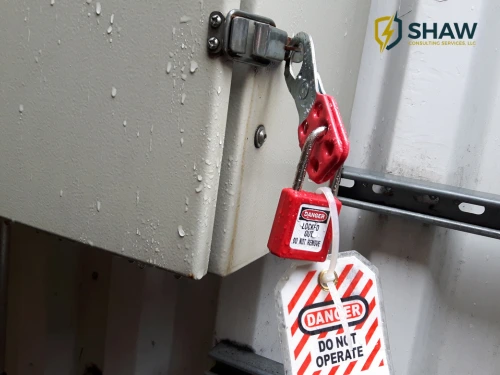
The physical devices (locks, tags, hasps, lockout blocks, valve covers) are what make the program tangible. OSHA has specific requirements for these devices that facilities sometimes overlook.
Audit questions to consider:
Are lockout devices standardized across the facility by color, shape, or size, and are they identifiable as lockout devices? Devices need to be distinguishable from other facility locks so there’s no ambiguity about their purpose.
Are devices durable enough to withstand the environment where they’re used? A lock used in a wet, corrosive, or high-temperature area needs to be rated for those conditions. Standard padlocks may not meet the durability requirement in all environments.
Are tagout devices legible and include the identity of the employee who applied them? Tags must clearly identify who applied the lock, warn against energization, and be attached with a means that prevents easy or accidental removal (not a twist tie or piece of tape).
Does every authorized employee have their own individually keyed lock? Sharing locks between employees defeats the fundamental principle of LOTO: the person who applied the lock is the only person who can remove it.
Periodic Inspections: The Requirement Most Facilities Miss
This is the single most commonly cited LOTO deficiency. OSHA 29 CFR 1910.147(c)(6) requires that energy control procedures be inspected at least annually. The inspection must be conducted by an authorized employee other than the one using the procedure being reviewed. It must include a review between the inspector and each authorized employee to verify understanding. And it must be documented with the date, the equipment or procedure inspected, the name of the inspector, and the names of the employees included.
Audit questions to consider:
Can you produce periodic inspection records for every energy control procedure in your facility, covering at least the past 12 months? If you have 40 machine-specific LOTO procedures, you need 40 annual inspection records. Not one blanket inspection covering all procedures simultaneously (unless each procedure was individually reviewed during that session), but individual documented reviews.
Was each inspection conducted by an authorized employee who is not the one routinely performing the procedure being inspected? This independence requirement exists for a reason. Self-auditing a procedure you follow every day doesn’t catch the drift that happens when shortcuts become habits.
For facilities in the greater Atlanta area, this inspection requirement is one of the first things OSHA compliance officers review during a planned or referral inspection. Having clean, current inspection records signals a mature safety program and often influences how deeply the inspector digs into other areas.
Group Lockout/Tagout and Contractor Coordination
When multiple employees or outside contractors perform servicing on the same equipment, the complexity of LOTO increases significantly. OSHA requires specific protocols for both scenarios.
Audit questions to consider:
Does your program include a group lockout/tagout procedure that defines how responsibility is transferred between the primary authorized employee and other members of the crew? In group lockout situations, one authorized employee must be designated as having primary responsibility. Each worker must still apply their own personal lockout device.
Do you have a documented process for coordinating LOTO with outside contractors? When your facility brings in a contractor to service equipment, both the facility and the contractor need to inform each other of their respective lockout procedures. The contractor’s employees must follow energy control procedures that provide protection at least as effective as your facility’s program. This coordination needs to happen before work begins, not when the contractor is already standing in front of the panel.
Procedure Updates After Equipment Changes
LOTO procedures are living documents. When equipment is modified, replaced, upgraded, or reconfigured, the associated energy control procedure must be reviewed and updated to reflect the new energy sources, isolation points, or verification methods.
Audit questions to consider:
Is there a documented process for triggering a LOTO procedure review whenever equipment is modified or new equipment is installed? Many facilities have a work order system for maintenance but no parallel trigger for updating LOTO procedures. That disconnect is how outdated procedures stay in circulation.
When was the last time your procedures were compared against the actual equipment they cover? Walk the floor with your procedures in hand. If the isolation points described in the document don’t match what’s physically present on the equipment, the procedure is invalid.
Turning the Audit Into Action
After working through this checklist, you’ll have a clear picture of where your program stands and where the gaps are. Document everything you find, both the items that pass and the ones that don’t. The items that fail become your corrective action list, prioritized by risk: missing procedures and expired inspections at the top, administrative and formatting issues at the bottom.
The goal isn’t perfection on paper. It’s a program that actually protects the people who rely on it every time they put a lock on a disconnect switch.
About Shaw Consulting Services
Shaw Consulting Services LLC is an Atlanta-based electrical engineering and consulting firm that helps facilities develop, document, and audit LOTO programs that hold up under regulatory scrutiny. If your program has gaps you’re not sure how to close, or if you need machine-specific energy control procedures developed by qualified engineers who understand your electrical systems, Shaw’s team can help. Contact Shaw Consulting to discuss your LOTO program.
Frequently Asked Questions
How often does OSHA require LOTO periodic inspections?
At least annually. Every energy control procedure must be individually reviewed at least once per year by an authorized employee who is not the person routinely using that procedure. The inspection must be documented with dates, names, and the specific procedures reviewed.
Can we use one generic LOTO procedure for all equipment?
Generally no. OSHA 29 CFR 1910.147 requires machine-specific procedures that identify the types and magnitudes of energy, specific isolation points, and verification methods for each piece of equipment. A single generic procedure is only acceptable if the equipment, energy sources, and steps are identical across all machines.
What records should we have ready if OSHA shows up?
Written energy control procedures for each piece of equipment, training records for all authorized, affected, and other employees, periodic inspection documentation for the past year at minimum, and records of contractor LOTO coordination for any outside servicing work.
Who can perform the annual periodic inspection?
An authorized employee (someone trained and authorized to perform lockout/tagout) who is not the employee routinely using the procedure being inspected. This independence requirement is specifically stated in 1910.147(c)(6).
What is the most common LOTO citation OSHA issues?
Failure to conduct and document periodic inspections is consistently among the top citations. Many facilities have written procedures and trained employees but lack the annual inspection records that prove the program is being actively maintained and reviewed.