
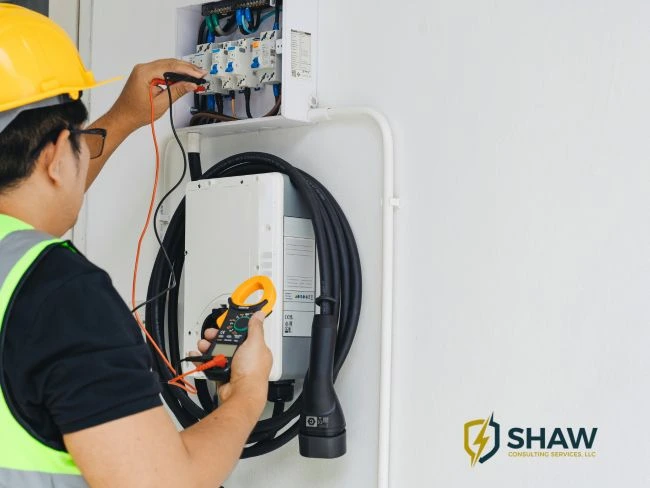
Adding EV chargers to a commercial or industrial facility introduces electrical safety risks that go well beyond the installation itself. Ground fault exposure increases in wet parking environments. Arc flash incident energy values can change at panels and switchgear that weren’t touched during the project. Workers servicing charging equipment face shock hazards that require specific training and PPE. If your facility is planning an EV charging installation, the electrical safety implications deserve as much attention as the charger selection and site layout.
This guide focuses on the safety side of EV infrastructure, not the design and planning process (which Shaw has covered separately). If you’re a facility manager or safety director, these are the risks you need to address before and after chargers go live.
EV Charging Creates New Shock Hazard Exposure
EV chargers operate at voltages and currents that present real shock risk, particularly in environments where water is a factor. Parking garages, surface lots, and curbside installations all expose charging equipment to rain, standing water, snow melt, and vehicle wash runoff. That combination of moisture and energized equipment creates conditions where ground faults are more likely and more dangerous.
NEC Article 625 requires ground fault circuit interrupter (GFCI) protection for EV charging equipment. But code compliance is the floor, not the ceiling. Facility managers should also consider the condition of grounding conductors and bonding connections at the point of installation, whether existing ground fault protection upstream of the new circuits is properly coordinated with the new GFCI devices, and how drainage patterns around the installation site affect standing water near electrical enclosures and junction boxes.
In the Atlanta area, afternoon thunderstorms and humidity are facts of life for most of the year. Facilities that install EV chargers in uncovered or partially covered areas need to account for these conditions in both the initial design and the ongoing maintenance plan.
Your Arc Flash Study May No Longer Be Accurate
This is the safety risk that gets overlooked most often. When you add EV charging circuits to your electrical distribution system, you may be adding new panels, breakers, feeders, or even a new transformer. Any of those changes can alter the available fault current and protective device coordination at points throughout your system, not just at the new equipment.
That means the arc flash incident energy values on your existing labels may no longer be correct. A panel that was labeled at 4.2 cal/cm² before the EV project could now have a different incident energy value because the upstream fault current changed. If a worker relies on that outdated label to select PPE, they could be underprotected.
NFPA 70E is clear on this point: arc flash risk assessments should be reviewed whenever a major modification is made to the electrical distribution system. Adding EV charging infrastructure, especially DC fast chargers that require dedicated transformers or significant feeder upgrades, qualifies as a major modification.
If your facility has an existing arc flash study, get it re-evaluated after the EV installation is complete. If you don’t have one at all, the EV project is a good trigger to get one done.
Overcurrent Protection Mistakes Create Fire Risk
NEC Article 625 requires that EV charging branch circuits be sized at 125% of the maximum load for continuous-use circuits. This seems straightforward, but it’s where shortcuts happen. Installers sometimes tap into existing panels without verifying that the panel bus rating, main breaker, and upstream feeder can handle the added load.
The result is a circuit that works fine most of the time but creates dangerous conditions during peak charging periods. Overloaded conductors generate heat. Breakers that are close to their trip rating cycle more frequently, degrading over time. Connections at termination points loosen faster under thermal cycling. All of these conditions increase the probability of an electrical fire or a fault that escalates into an arc flash event.
Facility managers should verify that every EV charging circuit has been independently calculated and properly sized, not piggy-backed onto existing circuits with minimal headroom.
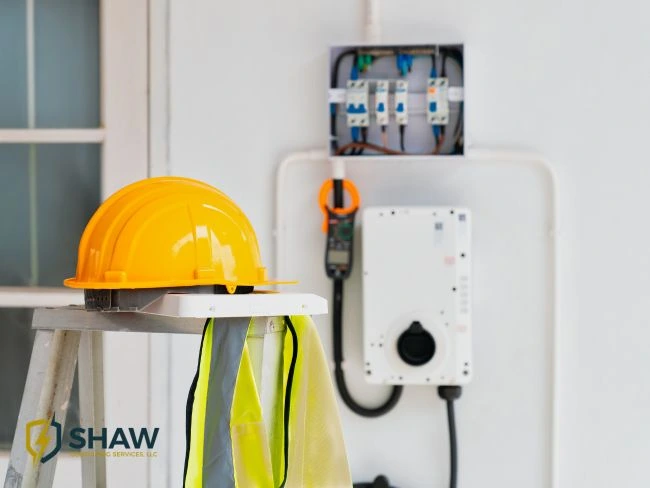
Workers Servicing EV Equipment Need Specific Training
Once EV chargers are installed, someone has to maintain them. Charging stations require periodic inspection of connectors, cables, enclosures, and internal components. Depending on how your maintenance program is structured, this work might be handled by in-house electricians, a third-party service provider, or the charger manufacturer’s field technicians.
Whoever performs the work needs to be qualified under NFPA 70E. That means they need training on the specific electrical hazards present at the EV charging equipment, including the shock risk from DC circuits in fast chargers (which behave differently than AC systems), the arc flash hazard at the panel or disconnect feeding the charger, the lockout/tagout procedures for de-energizing the charger and its supply circuit, and the PPE requirements based on the incident energy at the specific equipment location.
If your facility’s existing LOTO program doesn’t include machine-specific procedures for EV charging equipment, that’s a gap you need to close before the chargers go into service.
Cable Management Is a Safety Issue, Not Just an Aesthetic One
EV charging cables, conduit runs, and junction boxes in parking areas face physical abuse that typical interior electrical installations don’t. Vehicles drive over conduit. Charging cables get dragged across wet concrete. Junction boxes get hit by bumpers and shopping carts.
Damaged cables and conduit expose conductors. Cracked junction boxes let moisture in. Both create fault conditions that increase shock and fire risk. Your installation should include physical protection for all conduit runs in traffic areas (bollards, concrete covers, or below-grade routing), strain relief and retraction systems for charging cables, weather-rated enclosures with tamper-resistant fasteners, and a scheduled visual inspection program that checks for physical damage on a regular basis.
These aren’t just code requirements. They’re the maintenance items that prevent a minor cable nick from becoming a ground fault incident six months later.
Ventilation and Battery Thermal Runaway Considerations
For indoor EV charging installations (parking garages, enclosed lots, maintenance bays), ventilation is a safety factor. While modern lithium-ion batteries don’t produce hydrogen gas during normal charging, there is a separate concern: thermal runaway events during charging.
A vehicle battery experiencing thermal runaway can release toxic and flammable gases. If your facility charges EVs indoors, especially fleet vehicles that may charge overnight unattended, your ventilation system and fire suppression plan should account for this scenario. Some authorities having jurisdiction (AHJs) in the Atlanta metro area have begun requiring ventilation assessments and gas detection systems for indoor EV charging areas. Check with your local AHJ before finalizing any indoor installation.
The Safety Checklist Before Going Live
Before your EV charging installation is energized and opened to users, make sure you’ve addressed the following: GFCI protection is installed and tested on all charging circuits, your arc flash study has been re-evaluated (or a new one conducted) to reflect the system changes, all new panels and disconnects have accurate arc flash labels, LOTO procedures have been written for the EV charging equipment and its supply circuits, maintenance staff or contractors are trained and qualified under NFPA 70E, physical protection is in place for all exposed conduit, cables, and enclosures, and indoor installations have appropriate ventilation and fire safety measures.
Treating these items as project closeout requirements rather than afterthoughts will save you from safety gaps that are expensive and dangerous to fix after the fact.
About Shaw Consulting Services
Shaw Consulting Services LLC is an Atlanta-based electrical engineering and consulting firm that helps facility managers plan and execute electrical infrastructure projects with safety and compliance built in from the start. Whether you’re adding EV chargers, upgrading distribution equipment, or re-evaluating your arc flash study after a system modification, Shaw provides the engineering expertise and clear communication that keeps your project on track. Contact Shaw Consulting to discuss your EV infrastructure project.
Frequently Asked Questions
Does adding EV chargers require an updated arc flash study?
In most cases, yes. Any significant modification to your electrical distribution system can change the incident energy values at existing equipment. NFPA 70E recommends re-evaluating arc flash risk assessments after major system changes, and adding EV charging infrastructure typically qualifies.
What NEC article governs EV charging installations?
NEC Article 625 covers the installation requirements for electric vehicle charging systems, including wiring methods, overcurrent protection, GFCI requirements, and equipment specifications.
Do maintenance workers need NFPA 70E training to service EV chargers?
Yes. Anyone who works on or near energized electrical equipment, including EV charging stations and their supply circuits, must be a qualified person under NFPA 70E. This includes understanding the specific shock and arc flash hazards present at the equipment.
Are indoor EV charging installations more dangerous than outdoor ones?
They present different risks. Indoor installations require ventilation planning for potential battery thermal runaway events and may need gas detection systems. Outdoor installations face greater exposure to moisture and physical damage but have natural ventilation.
Who is responsible for LOTO procedures on EV charging equipment?
The facility owner or operator is responsible for ensuring that machine-specific LOTO procedures exist for all equipment where workers may be exposed to hazardous energy, including EV chargers and their electrical supply circuits.